
Replace Yourself Before Someone Else Does
If you're not slowly replacing yourself with AI agents in your own workflow, you're not doing it right.
Everyone is asking the wrong question about AI.
"Will it replace me?" is fear dressed up as analysis. It assumes you're a passenger. And it misses the colder truth underneath: nobody gets replaced. Output gets replaced. If your entire value is your output, then the day your output can be produced without you is the day there's no benefit in you being around at all.
That's the real stake. Forget the robot-took-my-job version. The version that should worry you goes like this: someone else automated my output, I had no hand in the system that did it, and now nobody can say what I'm here for.
So here's my position. If you're not slowly replacing yourself with AI agents in your own workflow, you're not doing it right. Replace your own output production, on your terms, while you're still the one who decides what the freed-up hours become. And I mean your workflow. The stuff you personally do every week, not your team's process or the company roadmap.
You're the driver or you're the cargo
The replacement conversation is always framed as something that happens to you. Your employer does it, or the market does, while you brace for impact.
Flip it. Agents don't replace people. They replace the production of output. That distinction splits everyone into two groups.
People who are their output. Their value is the artifact: the report, the code, the post, the deck. The moment something produces that artifact cheaper, they're interchangeable with it.
People who drive their output. They sit above the production layer. Agents handle the producing. They handle the deciding: which problems matter, what's worth making, what the next idea is. Automating the production doesn't threaten them, because the production was never the valuable part of them. The driving was.
If you don't build that layer for yourself, someone else eventually builds it around you. And the version they build doesn't include you.
What I've actually replaced
This isn't theory. Here's a sample of my own roster.
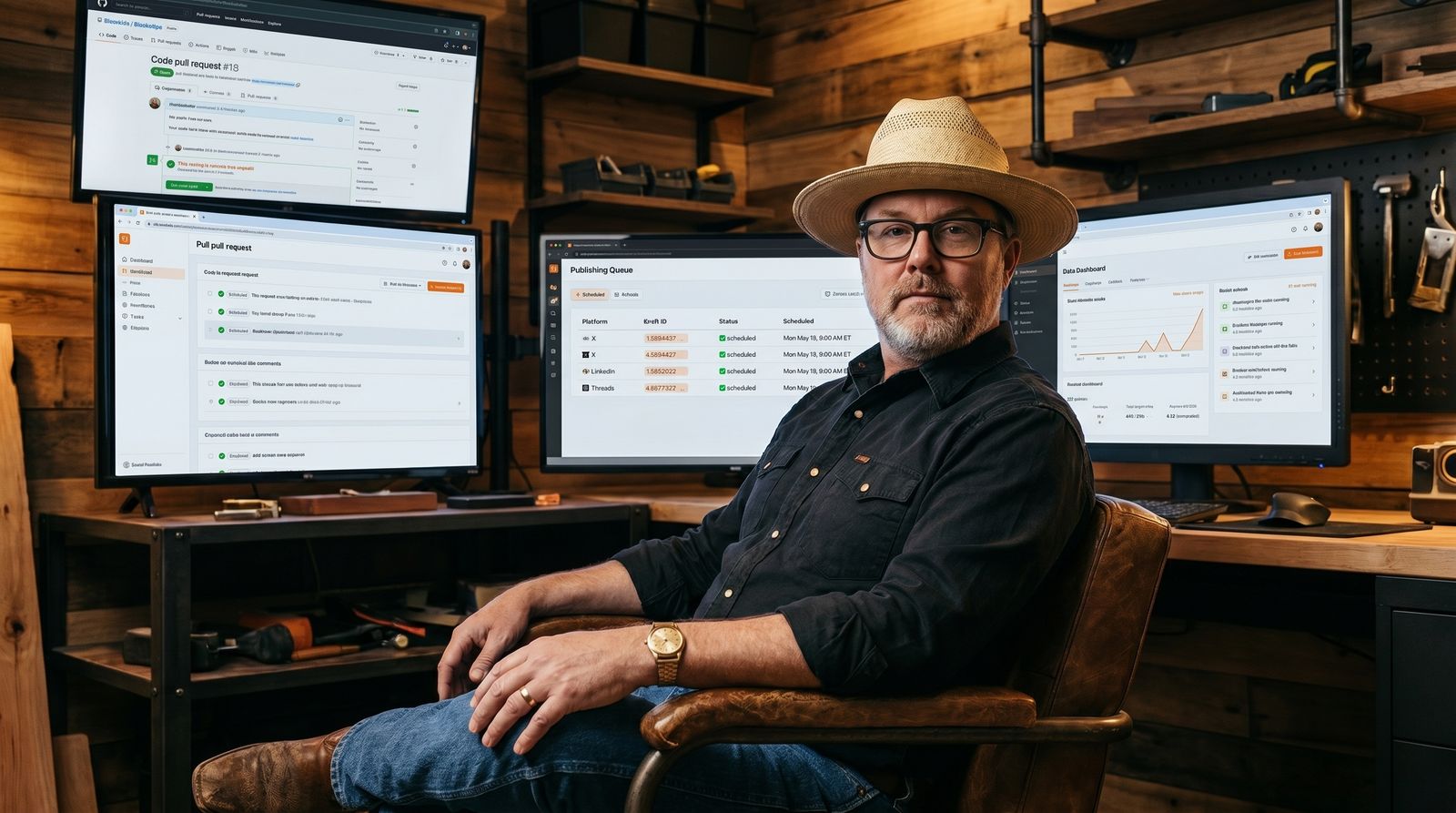
A bug fixer that works while I don't. I keep a queue of bugs as tagged notes. An agent reads the queue, diagnoses each one, writes the fix in the actual codebase, and opens a pull request for my review. It clears around ten bugs a week, and these are bugs I would never have gotten to at all. Calling that saved time undersells it. That's output that otherwise would not exist.
A training logger that knows my history. I finish a set at the gym, I say what I did, and an agent logs the exercise, weight, and reps against my full history, pulls heart rate data from my watch, and tells me what I did last session and what to try next. No spreadsheet. No app to thumb through between sets.
Content routines that publish while I build. Ideas get captured mid-conversation, drafts get shaped, campaigns get scheduled and distributed across platforms. The pipeline runs whether I'm at a keyboard or not.
That last one deserves a number. I have over fifteen years of unfinished drafts sitting in folders. Fifteen years of "I should write about that." This year alone I've published more than 80 posts. The difference is not discipline. I did not become a better person in January. I built agents, and the agents removed every step between having an idea and shipping it.
What the freed hours actually buy
Most people think the prize of automation is the time back. The actual prize is what the time becomes.
Every hour an agent hands back to me goes into the one thing no agent does: coming up with what's worth doing next. More ideas, more experiments, more contribution than I was physically capable of back when every working hour went into production.
Agents produce, the producing frees me to think, and the thinking gives the agents more to produce. The loop feeds itself. My output multiplied, and every unit of it traces back to a decision I made. Nobody can look at that system and wonder what I'm for. I'm the part that makes the whole thing worth running.
You're not deleting yourself. You're promoting yourself.
The playbook
If you want to start, here's the pattern that has worked for me.
1. Automate the thing you keep not doing. Skip the task you love. Go after the one that's been sitting on your list for months. That's where the leverage is, because a task you keep skipping doesn't get done slowly. It doesn't get done.
2. Context beats commands. A prompt produces generic output. An agent with access to your history, your conventions, and your past decisions produces output that sounds like you and fits your system. Build the knowledge base first.
3. Bound everything. Pull requests instead of direct pushes. Drafts instead of auto-publishes. Every agent gets a defined scope and a review gate. Trust is earned in production, same as with people.
4. Reinvest the hours into ideas. This is the step that separates drivers from cargo. Treat the time agents give back as idea capacity, and spend it deciding what to build, write, and ship next. The system compounds.
The machine behind all of this
Everything in that content example runs on something I built: BlackOps Center. It exists because my own workflow demanded it. For years I read those unfinished drafts as a motivation problem. They were a systems problem, so I built the system.
BlackOps is an authority engine. Agents handle the capture, the drafting infrastructure, the scheduling, the distribution, the analytics. You keep the voice, the perspective, and the judgment, because that's the part that makes you worth keeping around. AI-assisted, not AI-generated. The slop machines have the other lane covered.
The 80+ posts this year, the campaigns promoting them, even parts of this post's path from idea to published page, all of it moved through that machine. And every piece started with an idea I had time to have, because agents were producing while I was thinking.
So here's the question to sit with. Skip "will AI replace me?" and ask the one that matters: who builds the system that produces my output, me, or someone with no reason to keep me in it?
Pick one task. Bound it. Replace yourself on purpose, before someone does it without you.
This post came out of a Brain.
Talk through what you already know. BlackOps turns it into a structured knowledge base, then writes and publishes from it, to your own domain, X, LinkedIn, Threads, and your newsletter. No email until you have seen your Brain.
I wrote this post inside BlackOps, my content operating system for thinking, drafting, and refining ideas — with AI assistance.
If you want the behind-the-scenes updates and weekly insights, subscribe to the newsletter.
Related Posts

I Spent Years Automating My Obsidian Daily Note. Now It Files Itself.
For years I fed my Obsidian daily note by hand. Now an agent files my captures overnight, tells my thoughts from my tasks, and I wake up to a clear picture of what's next.
Claude Code Is Not Your Project Manager. The Artifacts Are.
A year ago I gave Claude a ROADMAP.md and called it my project manager. The post still ranks. The post is also out of date. Here is what Claude actually manages now.

I Watched a YouTube Video. Claude Wrote This Post.
I didn't open a second tab. I didn't copy-paste anything. I had a thought, told Claude, and this post landed in my BlackOps queue. Here's exactly what happened.