
Everyone's Mad Anthropic Killed OpenClaw Access. I'm Not.
I spent a month debugging it every morning. The people crying loudest aren't the ones who were actually using it.

Everyone's Mad Anthropic Killed OpenClaw Access. I'm Not.
I bought the Mac mini. I posted that OpenClaw was the future. I went all in.
A month later I was waking up every morning to fix something that broke overnight. I wasn't building anything. I was just maintaining the tool I thought was going to free me from maintenance.
So I came back to Claude Code. Tail between my legs.
What Actually Happened
The first few weeks with OpenClaw were genuinely exciting. The initial results felt like a step change. It was doing things that surprised me. I posted about it publicly, said it was the direction I was heading, and backed it with hardware.
Then something shifted. Prompts that worked reliably one day stopped working the next. The behavior wasn't consistent. Things I had built started quietly breaking. I'd fix one thing, something else would stop working. After a few weeks the pattern was clear: I was spending more time keeping OpenClaw operational than I was spending building anything with it.
I had become an OpenClaw issue tracker. That's not what I signed up for.
The problem wasn't that the tool was bad at first use. It was that it wasn't stable enough to build on. And when you're trying to run a SaaS product and build in public and have a day job, you don't have cycles to spend debugging your development environment every single morning.
Coming Back to Claude Code
I'd spent over a year with Claude Code before the detour. It was my primary environment. The muscle memory was there. When I came back it immediately felt like coming home, except the house had been renovated while I was away.
Claude Code had moved significantly in just a few weeks. New features, new agent patterns, /loop for session-level automation, Cowork scheduled tasks for durable recurring workflows. There was a lot to catch up on.
Here's the thing nobody tells you: taking a month off a fast-moving tool means you come back to a different tool. That's not a complaint. It's just the reality of building on top of AI infrastructure right now.
And Then Anthropic Made It Official
While I was finding my way back, Anthropic announced they're cutting off Claude subscription access for tools like OpenClaw. The noise online was immediate.
Here's my read: who could blame them. They built the better path. Claude Code, Cowork, remote sessions — the whole stack. They're not locking you out of anything, they're telling you to use the door they built instead of the window people were climbing through.
The loudest voices against the decision are the ones who built audiences around OpenClaw content. That's not the same as the people actually trying to get work done with it.
I'm getting work done. And right now that looks like this: scheduled tasks running my daily notes briefing every morning. Calendar integration planning my day before I open a single app. Remote control into Claude Code on my Mac mini from my phone, from anywhere. Full session control without being at a desk.
Everything I was trying to get OpenClaw to do. Working. Without a morning debugging ritual.
That's not a knock on the people who built OpenClaw. It's just the reality of building on top of a platform — sometimes the platform ships the feature and the third-party workaround becomes unnecessary.
What I'm Figuring Out Now
Right now I'm doing two things in parallel.
First, I'm mapping what's actually new in Claude Code and figuring out what's worth adopting. The /loop command lets you run repeated agentic tasks inside a session. Cowork scheduled tasks let you run them on a real schedule, independent of whether you have a terminal open. Those are meaningfully different use cases and the distinction matters depending on what you're automating.
Second, I'm implementing Claude Code at work. I'm a frontend architect at one of the Big 4 consulting firms and we've started rolling out Claude Code across the SAP CX team. So I'm navigating both the personal workflow side and the enterprise side at the same time. The enterprise considerations are different. Permissions, auditability, what you can and can't connect to. That's a whole separate set of tradeoffs I'm working through.
The Actual Lesson
I don't regret the OpenClaw detour. I learned something real: consistency matters more than ceiling. A tool that works reliably at 80% is more valuable than a tool that occasionally hits 100% but breaks unpredictably. I was chasing the ceiling and ignoring the floor.
Claude Code has a higher floor. I know that now in a way I didn't before I left.
I'm documenting all of this as I go. The discovery process, the feature comparisons, the enterprise rollout. If you've been watching from the sidelines trying to figure out what to actually use and how to use it, stick around. That's exactly what I'm figuring out in public.
Building BlackOps Center. Writing about AI-assisted development at benenewton.com.
This post came out of a Brain.
Talk through what you already know. BlackOps turns it into a structured knowledge base, then writes and publishes from it, to your own domain, X, LinkedIn, Threads, and your newsletter. No email until you have seen your Brain.
I wrote this post inside BlackOps, my content operating system for thinking, drafting, and refining ideas — with AI assistance.
If you want the behind-the-scenes updates and weekly insights, subscribe to the newsletter.
Related Posts

The Work Starts When the Thought Does
Self-healing software survives its bugs without changing a line. What I run against my projects changes the source. Logging the defect is what fires the work, and most days the completion email is the entirety of my involvement.
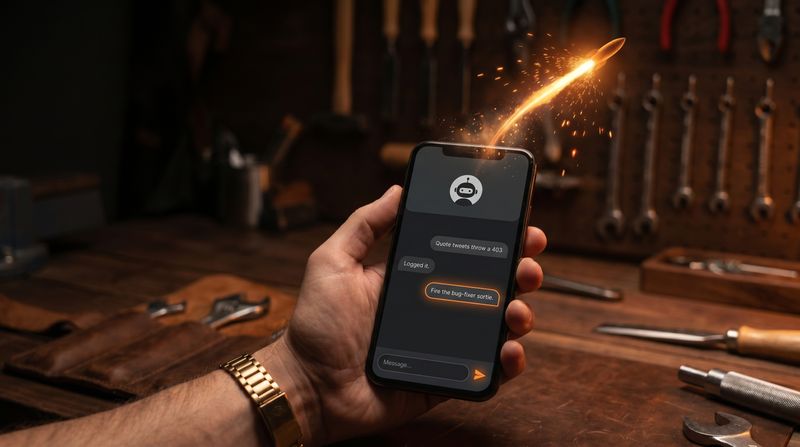
Sorties: Fire Real Actions Straight From Your AI Chat
A Sortie turns a sentence in your AI chat into a real action. Fix a bug, message your team, fire an automation. Set it up once, fire it by name from anywhere, and your keys never touch the conversation.
I Gave Claude Code the Voice of Rocky From Project Hail Mary
I started with Rocky reading every reply aloud. It was too much. Now Claude Code cheers once, in Rocky's voice, when something big lands.