
How I Use BlackOps to Reply on X Without the AI Slop
I run each Hunt as a live search on X, the extension scores the results and drafts only when something I actually wrote answers the tweet, and it tells me no the rest of the time. I send every one myself.

Everyone trying to grow on X right now is being told the same thing. Reply to twenty tweets a day. Get in the comments early. Volume wins. And you can feel the result in every timeline, a wall of confident, generic, AI-flavored replies that all sound the same and add nothing.
I reply to three or four conversations a day. On purpose, with BlackOps, the platform I built, set up to keep it that way.
This is not a reply generator
Let me be clear about what this isn't, because the category is crowded. There are tools built to help you reply to as much as possible, SuperX being the best known. They watch the timeline, generate a plausible reply to anything moving, and keep you visible all day. If that's what you're looking for, go sign up for SuperX, it does that job well.
I built the opposite tool, because I think that job produces the slop everyone's tired of. A generated reply isn't bad because a machine drafted it. It's bad because it isn't attached to anything, no experience, no receipts, no reason it had to come from you. Swap the account name and nobody would notice. BlackOps has one unbreakable rule that kills that failure at the root: it is not allowed to say anything I can't back with something I actually wrote. Which means most of the time, it says nothing at all.
Where the replies come from
A Hunt is a saved definition of a conversation I want to be part of: a plain-English description of who I'm looking for and what I want to say when I find them. One of mine looks for professionals admitting they can't publish consistently. Another follows people arguing about owning your own AI setup instead of renting everything.
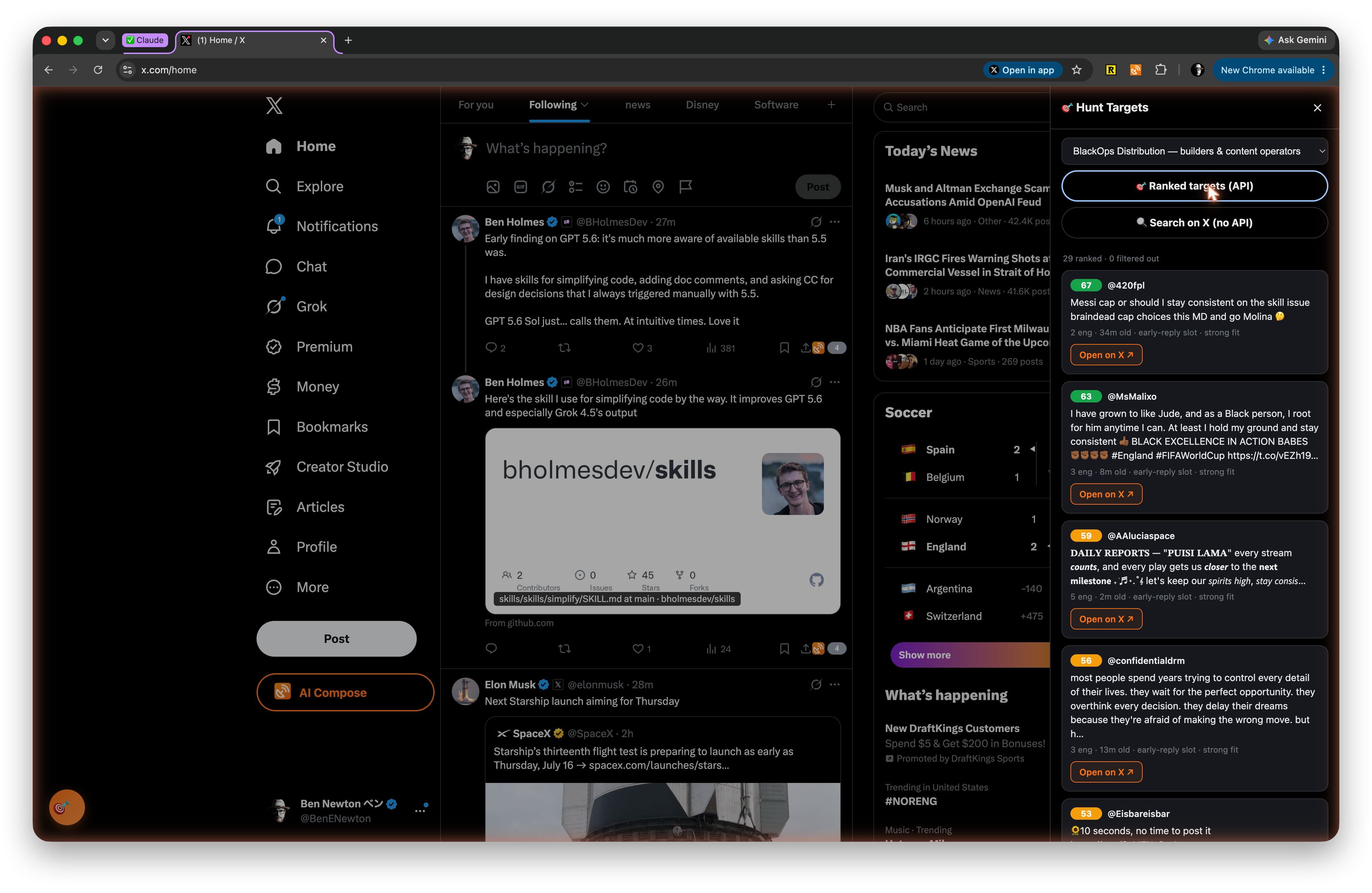
When I want to work a hunt, one click in the extension turns it into a real search on X, live tab, right in my browser. As the results load, the extension scores them against the hunt and flags the few where I have standing to answer. It checks that the tweet is really about what I think it's about, that the author is a person and not a content feed, and that something I've written genuinely answers them. That's the targeted version, and it's the main event: I go looking for my conversations on purpose.
The rest of the time I'm just reading X like anyone else, and the same hunts ride along, flagging the occasional tweet worth answering as it scrolls past. Deliberate first, serendipity as a bonus. Everything else gets left alone.
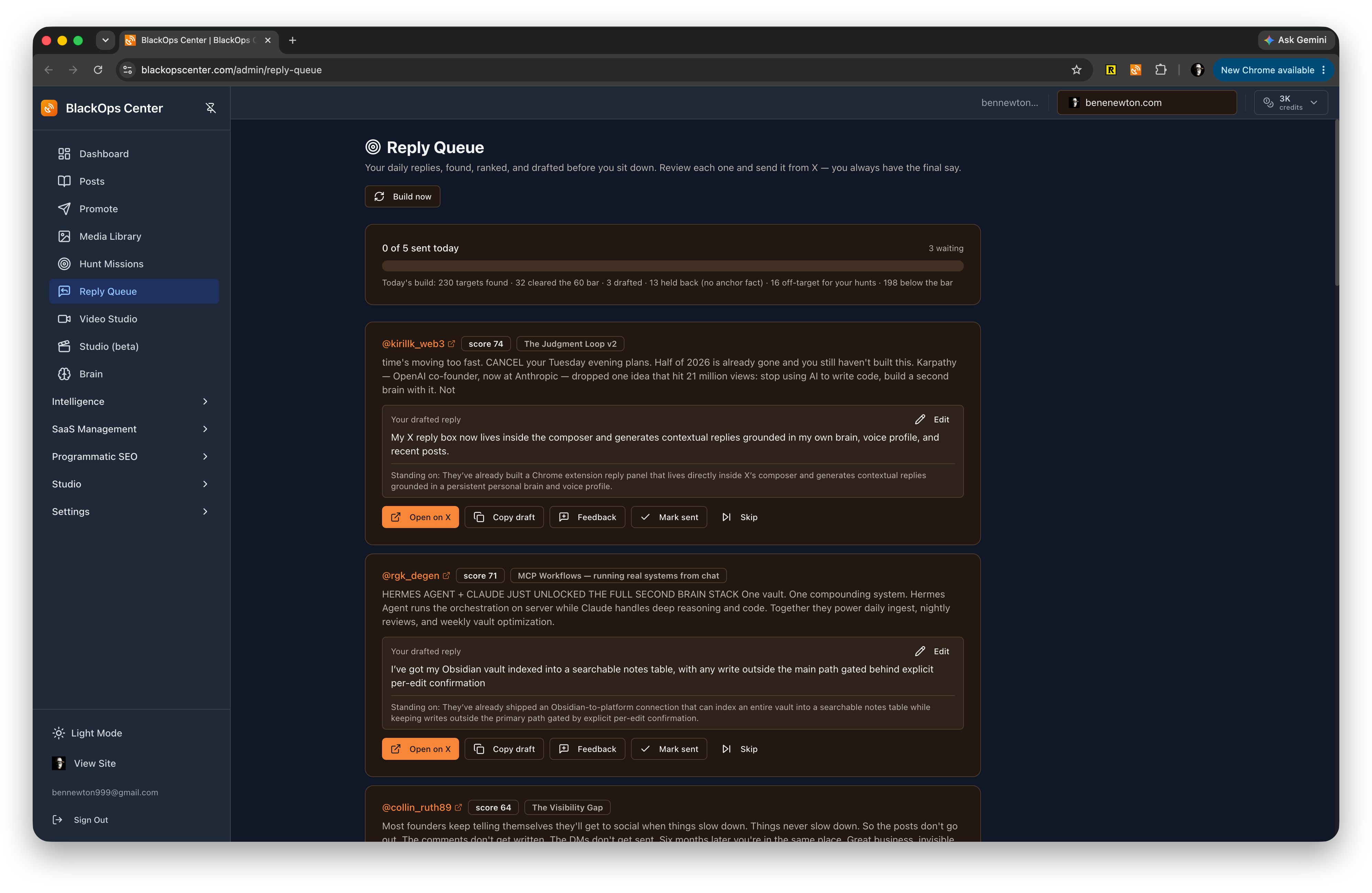
When I first turned this on, I let it search X on a schedule for a week to see what volume really looks like. One morning's line: 230 targets found, 32 cleared the bar, 3 drafted, the rest held back or ruled off-target. It read 230 conversations and decided I had something worth saying in exactly 3 of them. That ratio is the whole argument against the volume advice, and it's why the hunts now run where I can see them, one targeted search at a time, instead of a scheduler churning in the background. The no's are still itemized, not hidden.
Every draft shows its receipt
Under every draft sits a line that reads "Standing on:" followed by the exact fact the reply was built from, pulled from my own notes or a post I published, and verified word for word against the source before the draft was allowed to exist. If the machine can't produce that receipt, the tweet lands in a separate "Found, but held back" section that says why, in plain words: nothing I've written speaks to this tweet's actual point. There's a Draft anyway button next to each one, my judgment can override the system's, but it takes my click. Nothing below the bar gets written on its own.
Then I send them myself
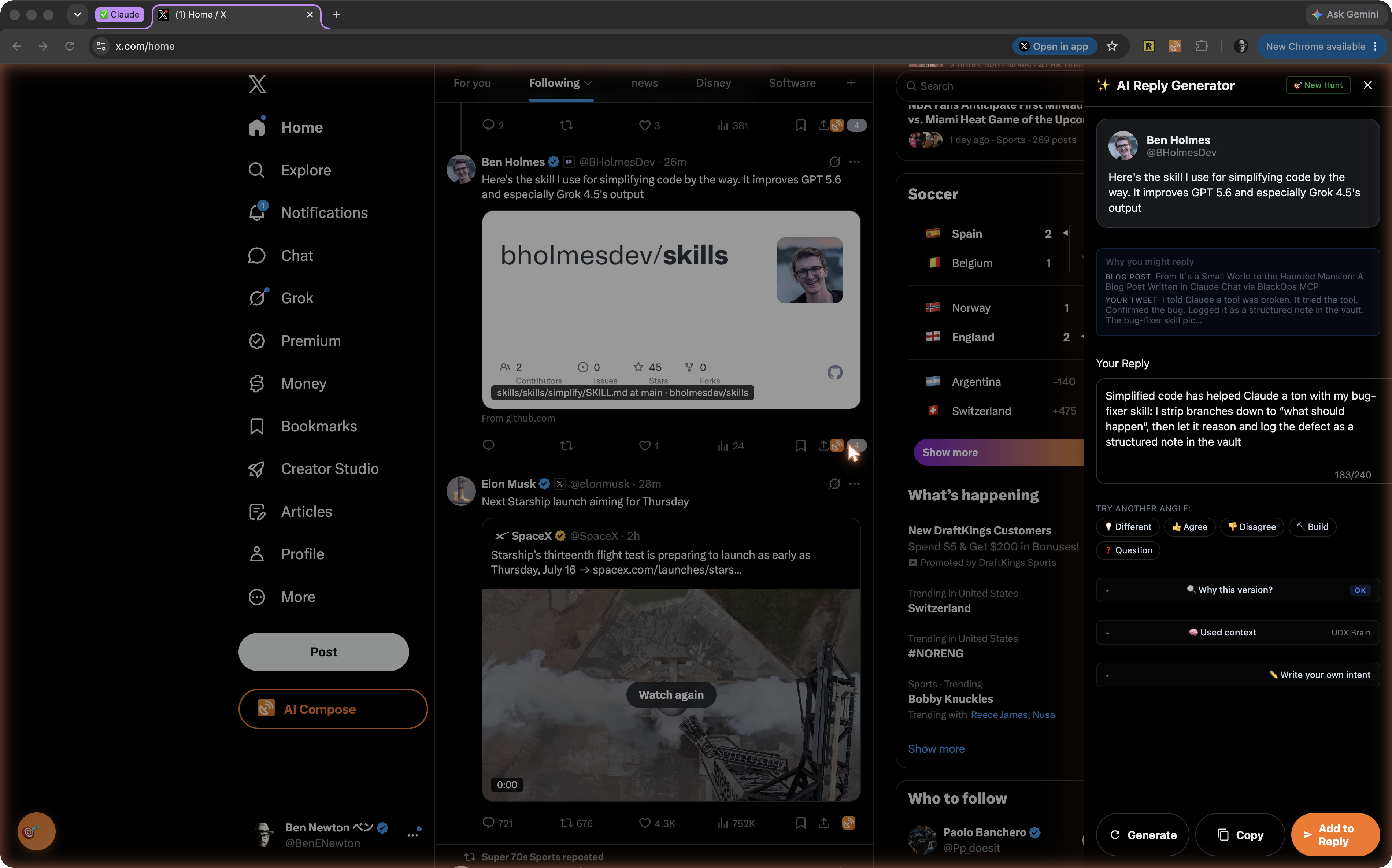
The system cannot post. The X API doesn't allow automated replies, and I wouldn't use it if it did. When I open a flagged tweet, the extension stages the draft right inside X's native reply box, where I can read it one last time, change a word, or rewrite the whole thing before I hit reply with my own hand.
The Hunt Targets panel is where all of it starts. It's the one-click search for every hunt, and it scores whatever page I'm already on, so I can see what's worth answering and what each draft would stand on without leaving X.
It learns me, both ways
When I edit a draft before sending, the system keeps my version next to its version and learns how I would have said it. When a draft misses in a way an edit can't fix, I tell it what went wrong in a sentence or two, and it turns that into a standing rule it follows from then on. I can read every rule it has learned and delete any I disagree with.
So the drafts get more like me every week, in wording and in judgment. Not because I wrote a clever prompt, because I corrected it in small ways every day and it kept the receipts.
My posts do the replying now
The newest piece closes a loop I've wanted for years. My published posts feed the system too. When a reply stands on something from one of my posts, it can bring the post's link along. Only then, and rarely, about one reply in twenty. A link that isn't backed by the exact thing the person needed is just more noise, and there's plenty of that already.
Which means a post I published last month is still out there answering people, one conversation at a time, in threads I never would have found by scrolling. Write it once, and it keeps working.
Why one beats twenty
A good reply is a small act of service. Somebody asked a real question or hit a real wall, and someone who has been there answered with something specific. That's the entire reason replies ever worked as a way to get known. The volume advice strips out the service and keeps the schedule, and the timeline shows what's left.
Three replies a day, each standing on something real, each sent by my own hand, beats twenty generated ones every time it matters. The people reading can tell the difference. So can the person you answered.
Everything above is the reply engine in BlackOps Center. But the practice matters more than the tool: say less, stand on what you actually know, and let the no's do their job.
Have you found a way to reply on X without sounding like AI soup, or are you still stuck between silence and generic? Reply on the X thread below. I read them.
This post came out of a Brain.
Talk through what you already know. BlackOps turns it into a structured knowledge base, then writes and publishes from it, to your own domain, X, LinkedIn, Threads, and your newsletter. No email until you have seen your Brain.
I wrote this post inside BlackOps, my content operating system for thinking, drafting, and refining ideas — with AI assistance.
If you want the behind-the-scenes updates and weekly insights, subscribe to the newsletter.
Related Posts

I Predicted One Senior Dev and an Army of Agents. Tonight It Happened.
Last year I predicted the future dev team: one senior engineer and an army of AI agents. Tonight, from a phone at Epcot, I watched 10 AI agents run a standup, find production bugs, debate priorities, deploy fixes, and verify them. The prediction is no longer a prediction.

I did not want another writing tool
Every AI writing tool opens with a blank box and asks what you want to write about. Then the model invents something, and it reads like it was written by someone who has never done the work. The gap worth closing is not writing. It is the hour between knowing something and having published it.

How I use a BlackOps brain to track my deploys
I asked BlackOps for a brain called Deployment Log, backfilled 34 deploys into it out of the build logs, and it caught a failed build I had never recorded plus a fix I had already made too narrowly.